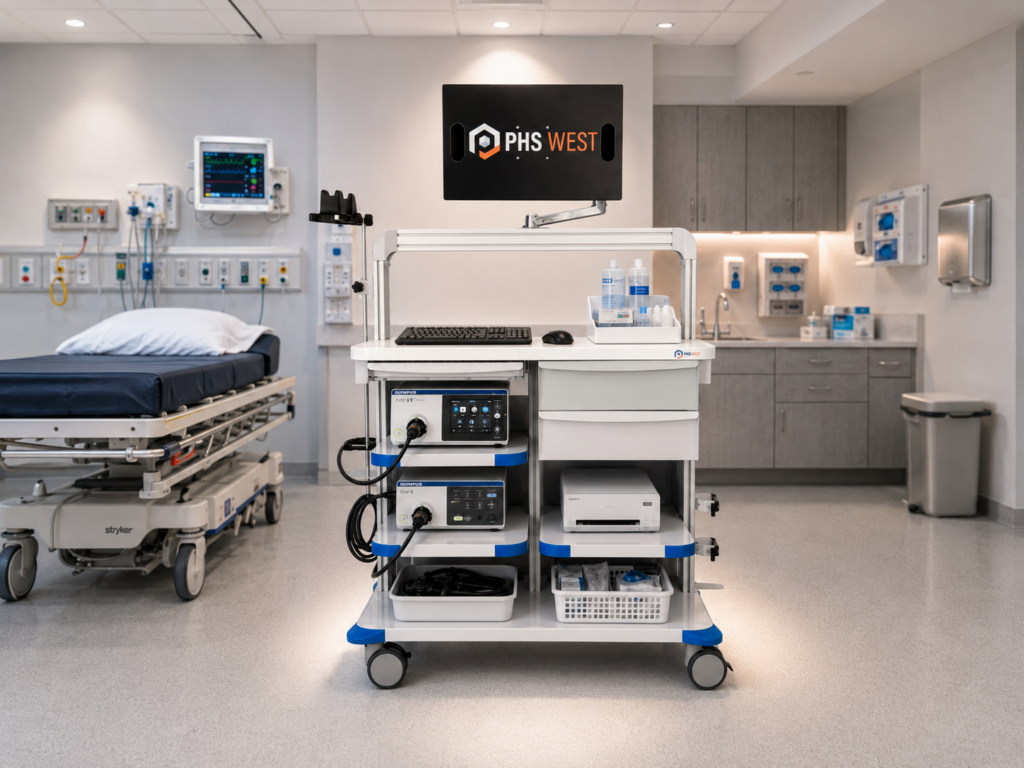
Not all endoscopy carts are created equal.
Some glide. Some wobble. Some neatly hold everything your team needs. Others turn into a rolling junk drawer with a monitor on top and cords everywhere.
When you are working in a busy GI department, you do not have time for “good enough.” You need an endoscopy cart that fits your equipment, supports your workflow, keeps supplies accessible, and does not make your staff wrestle it down the hallway.
Here are a few helpful things to think through so you can find the right cart for your team, your space, and your needs.
1. Know how the cart will actually be used
First things first: where is this cart going?
Will it live in a procedure room? Move between rooms? Travel to patient rooms? Support bedside procedures? Make frequent trips through hallways, elevators, thresholds, and tight spaces?
That answer matters. A cart that works beautifully in a dedicated procedure room may not be the right fit for travel cases. A travel cart that handles long distances like a champ may be more than you need for a compact procedure space.
Think about:
• Where the cart will be used most often
• How far it needs to travel
• How often it will move
• Whether it needs to fit into confined rooms
• Who will be pushing, pulling, steering, or positioning it
Because the best cart is not just the one that looks good in a product photo. It is the one that behaves itself at 7:15 a.m. when the day is already moving fast.
Monitors, processors, imaging equipment, supplies, accessories, cables, power components, baskets, drawers, and whatever else your team relies on should all be part of the equation.
Consider what needs to be:
• Stored
• Mounted
• Powered
• Accessed quickly
• Protected during transport
• Separated from other supplies
PHS West configures our endoscopy carts around your equipment and workflow, which means the more your team knows going in, the better the final workstation can be. Our carts use modular components so shelves, accessories, and storage options can be positioned around specific supply and equipment requirements.
3. Do not underestimate storage
How would you set up your storage space?
One minute you have a clean, organized workstation. The next minute, supplies are multiplying, drawers are overstuffed and someone is asking where that thingy is. You know. The thingy everyone needs immediately, but no one can find.
The right endoscopy cart should make supplies easy to access without turning the workstation into a cluttered obstacle course.
Ask yourself:
• Do you need drawers, shelves, bins, baskets, or accessory mounts?
• Which supplies need to be accessed most often?
• What should be stored together?
• What needs to stay visible?
• What needs to stay protected?
Our PHS West procedure room carts are built to keep endoscopic equipment and supplies where your team needs them, with accessories and storage systems that can be configured.
Your cart should work like a workstation, not a scavenger hunt.
4. Get your cords in order
Are tangled cords disrupting your workflow?
They tangle. They drag. They get in the way. They make setup messier than it needs to be. In a clinical space where organization matters, unmanaged cords are not exactly bringing calm, competent, and ready for the day energy.
Think about:
• How many devices need power
• Where cords need to run
• How often equipment is connected and disconnected
• Whether cords interfere with drawers, movement or access
• How the setup looks and functions during an actual procedure
Our PHS West Double Endoscopy Cart includes integrated cord management along with ample storage space and enhanced ergonomics. And honestly? Anything that helps reduce the dreaded cord nest deserves a moment of applause.
5. Think about mobility before someone has to push it
Are heavy travel carts slowing down your room-to-room transitions?
A cart can have all the storage in the world, but if moving it feels like a gym workout nobody signed up for, that is a problem.
Mobility matters, especially if your cart travels between rooms or supports bedside cases. Look at the real conditions it will face hallway length, turns, thresholds, flooring, elevators, ramps, and tight patient rooms.
Consider:
• Cart size and footprint
• Caster quality
• Stability during movement
• Turning radius
• Brake placement
• Handle position
• Staff effort required to move it
• Whether motorized assistance would help
For facilities handling travel cases, PHS West offers endoscopy carts that can be fitted with a power drive system, allowing staff to engage the throttle and guide the cart without unnecessary strain.
6. Match the cart to your space
How well does your endoscopy cart match your available square footage?
Some teams have dedicated procedure rooms with more space to work. Others are navigating compact rooms, shared areas or tight patient-room setups. Your cart should fit the space without forcing everyone to perform a carefully choreographed hallway ballet.
Think through:
• Room dimensions
• Doorway width
• Storage space when the cart is not in use
• Clearance around beds, tables and other equipment
• Whether the cart needs to turn in tight areas
• How many people need access to the workstation at once
At PHS West we offer multiple endoscopy cart styles, including Single Endoscopy Carts for smaller procedure spaces and Tower Endoscopy Carts for added height and more storage configuration options.
The goal is not to cram a cart into a room and hope everyone adapts. The goal is to configure a workstation that fits how the room functions.
7. Prioritize ergonomics, because your staff are not robots
What cart features are you prioritizing to ensure comfortable access and easy steering?
GI teams do a lot. Reaching, bending, moving, setting up, tearing down, transporting, organizing, and adjusting on repeat all day.
An endoscopy cart should help reduce unnecessary strain, not add to it. Ergonomics may not sound glamorous, but neither does shoulder fatigue, awkward pushing, or bending around a poorly arranged cart for the hundredth time.
Look for features that support:
• Comfortable access to supplies
• Practical working height
• Easy steering and positioning
• Reduced push/pull effort
• Clear visibility of equipment
• Logical placement of accessories
• Less awkward reaching or bending
At PHS West we describe our endoscopy carts as workstations designed for efficiency, flexibility, ergonomics, and accessibility.
8. Plan for infection prevention workflows
How does your endoscopy cart support your department’s infection prevention workflows?
An endoscopy cart is not an infection prevention program by itself. But a well-designed cart can support better workflow habits by reducing clutter, improving organization, and making surfaces and supplies easier to manage. When teams can find what they need, keep equipment positioned properly, and avoid unnecessary mess, the work environment feels more controlled.
Ponder:
• Are supplies organized and easy to access?
• Are surfaces overcrowded?
• Can staff clean around stored items and mounted accessories?
• Does the cart layout support your department’s process?
• Are clean and used items clearly separated according to your facility’s procedures?
A cart should help your team maintain order, not create a rolling mess.
9. Think customization
Why use a generic workstation when your department has specific demands?
One-size-fits-all sounds convenient until it fits absolutely no one particularly well.
Your department has specific equipment. Your rooms have specific layouts. Your team has specific preferences. Your procedures have specific demands. So why settle for a cart that acts like all endoscopy teams work the exact same way?
At PHS West we specialize in a collaborative process, with our team working directly with you to configure endoscopy carts around your equipment and needs.
Your cart should be designed around your workflow, not the other way around.
Customization can include:
• Cart style
• Shelf placement
• Drawer and storage configuration
• Accessory mounting
• Cord management
• Power drive options
• Travel-cart features
• Compact-space solutions
The more specific you are about your needs, the better the final configuration can be.
A cart is an investment. Choose one that can keep up.
Your equipment may change. Your procedure volume may grow. Your department may expand. Your team may realize six months from now that the extra storage option everyone debated was, in fact, the correct answer.
Always consider:
• Durability
• Long-term support
• Replacement parts or accessories
• Future configuration changes
• Service and technical support
• Product lifespan
• Whether the cart can adapt as needs change
We have provided endoscopy teams with equipment storage and transportation solutions for more than three decades, and we back our carts with 24/7 customer support for the life of the purchase.
Your cart is part of daily patient care workflows, support should not disappear after delivery, it matters.
Ready to find the cart that fits your workflow instead of fighting it?
Get a head start and gather:
• Equipment list
• Approximate equipment dimensions and weights, if available
• Procedure room or storage space dimensions
• Travel distance, if the cart will move between rooms
• Current pain points with existing carts
• Storage options
• Power requirements
• Cord management needs
• Quantity of carts needed
• Any must-have accessories
• Photos of your current setup, if helpful
The more your team can share, the easier it is to configure a cart that solves actual problems instead of creating new ones with nicer wheels.
The bottom line
An endoscopy cart is not just a cart.
It is a workstation. A storage system. A transport solution. A workflow helper. A cord wrangler. A supply organizer. A staff-sanity preservation device.
When you are choosing an endoscopy cart, look beyond the basic footprint and ask how it will function in your world: with your equipment, your team, your rooms, your procedures, and your day.
Request a quote or schedule a virtual demonstration to get started now!